Threema. The Secure Messenger
- 3.8
- Rating
- 5.00M
- Installs
- $7.49
- Price
 Analysis by App-foxy
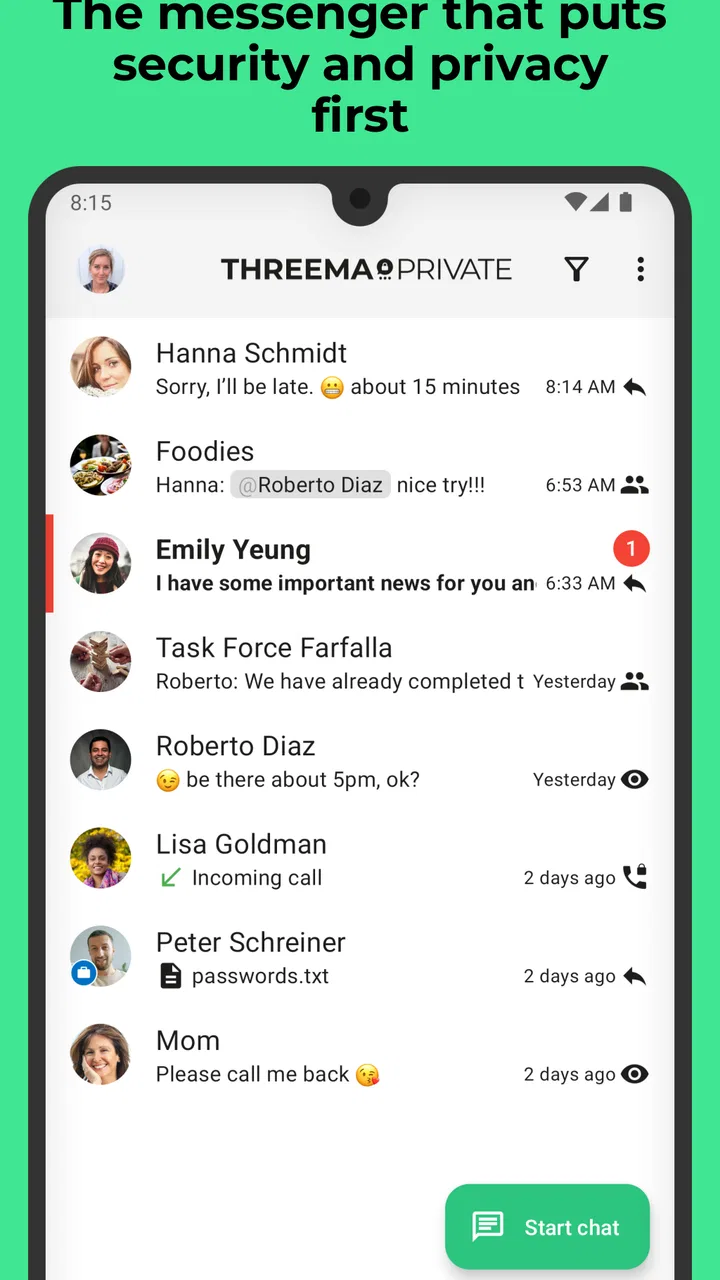
I approached Threema as a paid communication app rather than just another chat download, and that distinction matters from the first minute. Its purpose is clear: give people a messenger built around security and privacy, while still handling the everyday work of sending messages and staying in touch. I found the experience more deliberate than the usual free alternatives, with less emphasis on attracting everyone and more emphasis on making privacy the reason to choose it.
Threema is developed by Threema AG and belongs to the communication category. It has been available since May 27, 2013, so this is not a new experiment trying to prove that private messaging is possible. It has built a recognizable place for itself among people who are willing to pay directly for a messenger instead of treating advertising, data collection, or a large social network as the price of entry.
The Android version reviewed here is version 6.5.1 and supports Android 7.0 and later. The app is rated for Everyone, which makes it suitable for ordinary personal communication as well as practical conversations between relatives, colleagues, and small groups. Its current average is 3.8 from around 76 thousand ratings, while the app has passed 5 million installs. Those figures suggest a substantial user base, although it remains much smaller than the dominant free messengers most people already have on their phones.
You May Also Like

 Blood Strike: 2.5 Anniversary
Blood Strike’s Loadouts Turn Every Drop Into a Tactical Gamble
A close look at Blood Strike’s custom loadouts: how fast access to signature weapons reshapes its battle royale rhythm, rewards preparation, and narrows the gap between fights.

 Pandora - Music & Podcasts
Pandora’s Music Is Easy to Start, but Harder to Recover
Pandora’s strength is its low-effort path from a seed to a station. Its weak spot is how much confidence it asks you to place in connection, setup, and quiet recovery.

 8 Ball Pool
 Is Built on Rivalries, Rematches, and Routine
A close look at the rivalries, rematches, shared routines, and unanswered safety questions that turn a quick pool match into a persistent mobile community.

 Samsung Music
’s Quiet Strength Is Playing What You Already Own
Its reach comes less from spectacle than from dependable access to a personal library. That simplicity is both the app’s strongest retention engine and its ceiling.

 AccuWeather: Weather Radar
AccuWeather Review: A Quick, Clear Forecast for Everyday Decisions
For everyday plans, the best forecast is the one you can understand quickly. AccuWeather makes rain timing, radar, and local conditions easy to act on, with a few trade-offs.

 Hill Climb Racing
Why Hill Climb Racing Still Turns Crashes Into One More Run
A tiny car, a bumpy hill and one more upgrade: Hill Climb Racing keeps resurfacing because its simple chaos makes every near-miss feel personal.
More From Our News Desk



How the paid model changes the experience
The listed price is $7.49, and that is the central fact to consider before installing it. This is not a free download that later asks you to decide whether privacy features are worth paying for. You pay for the app itself, which makes the decision simple but also raises the standard: I expect a paid messenger to offer a clear reason to leave a familiar free service.
That price can feel reasonable if you see private communication as something worth purchasing directly. It can feel unnecessary if your friends, family, or work contacts already live inside another messenger and have no interest in moving. The app’s value is therefore partly technical and partly social. A secure tool is much less useful when the people you need to reach refuse to use it.
I also appreciate that the cost is easy to understand. There is no need to compare a free tier with several paid plans in order to work out what basic messaging includes. At the same time, the purchase does not magically solve the network problem. You may still need to keep another messenger installed for contacts who are not on Threema, so some people will effectively be paying for an additional communication channel rather than replacing everything else.
That is the first practical question I would ask a friend: “Who will I actually message there?” If the answer is a partner, family group, professional team, or privacy-conscious community that is ready to use it, the purchase has a clear purpose. If the answer is “almost nobody I know,” the app may be admirable without being useful enough for your routine.
Privacy is the product, not a decorative setting
The strongest part of the experience is its consistency. Many messengers mention privacy somewhere in their settings while making convenience, social discovery, and platform growth the main experience. Threema feels designed around the opposite priority. That does not mean every user will notice a dramatic feature that changes how a message is sent. Instead, the benefit appears in the overall relationship with the app: communication is the point, not a doorway into a wider platform.
For me, this changes how I think about conversations that do not belong on a public social network or inside an advertising-driven ecosystem. A family discussing travel arrangements, a small group coordinating a sensitive project, or two people sharing personal details can choose a messenger because of its privacy posture rather than simply because it happens to be popular.
A useful but easily overlooked trade-off is that privacy often requires more intentional behavior. You cannot assume that every contact will already be available, that every group will exist, or that your normal social circle will move with you automatically. The app rewards people who make a conscious choice about communication, but it is less convenient for someone who wants instant access to the largest possible audience.
Everyday use: where it feels natural
Imagine that I am organizing a weekend trip with three friends. We need one place for the address, arrival times, a few personal details, and last-minute changes. In a mainstream messenger, the conversation may be easy to start because everyone already has an account. With Threema, the first step is making sure each person is willing to join and knows how to connect. Once the group is established, the privacy-focused choice makes more sense because the conversation stays within a tool chosen specifically for that purpose.
This same pattern applies to a household that wants a private family channel, a freelancer discussing client matters, or someone who wants to separate close personal conversations from a large social account. The app is especially appealing when the group is small enough to coordinate the switch and when the subject matter makes privacy more important than broad reach.
I would not choose it as my only messenger if my daily life depends on contacting a wide mix of people, businesses, clubs, or casual acquaintances. The usual alternatives win decisively in reach and familiarity. Their greatest advantage is not necessarily that they are better designed; it is that people are already there. Threema has to earn its place through trust and purpose rather than sheer ubiquity.
What the smaller network means in practice
The number of installs shows that the app is established, but it does not make it universal. That difference matters more than a store page can communicate. Before paying, I would make a list of the people I regularly contact and ask how many are prepared to use a separate messenger. This simple check is more useful than comparing screenshots or reading a long feature list.
There is also a psychological advantage to a paid app: the people who join are more likely to have made a deliberate decision. That can create a focused community where conversations are less tied to public profiles and less likely to be mixed with entertainment or promotional content. The downside is equally clear: every new contact requires another small act of coordination.
For a privacy-minded household, that coordination may happen once and then become routine. For a person who communicates with dozens of loosely connected groups, it can become constant friction. This is one of the most important distinctions between Threema and a free, dominant messenger. The former asks you to choose your communication circle; the latter usually gives you the circle you already have.
Questions I would settle before buying
The first question is whether the app works on an older phone. The stated minimum is Android 7.0, so anyone using an earlier Android release should check compatibility before spending money. For supported devices, version 6.5.1 is the current version covered by this review, and the Everyone age rating makes it broadly approachable from an audience standpoint.
The second question is whether paying once fits your expectations. The listed purchase price is $7.49, so I would treat the decision as buying a privacy-oriented tool, not signing up for a free trial. If you are only curious and have no contact ready to join, waiting may be wiser than purchasing on impulse.
The third question is whether you can persuade the people who matter. A private messenger cannot replace a social network’s reach by itself. I would explain the reason for switching clearly, start with one important conversation, and avoid trying to move every contact at once. A small successful group is a better test than an empty installation.
The fourth question is what kind of privacy you actually need. If your main complaint is advertising or unwanted social features, Threema’s focused approach may be attractive. If you need a particular workplace integration, a large public community, or effortless communication with almost anyone, a more common alternative may be the better tool. Privacy is valuable, but it is not the only requirement in a messenger.
Small habits that make the purchase worthwhile
I would use Threema for conversations that deserve a clearly chosen private space rather than installing it and hoping the rest of my contacts appear. That means creating a short list of priority contacts, agreeing on one group for a specific purpose, and keeping the app’s role clear. This avoids the common mistake of judging a specialist messenger by whether it can replace every other communication service immediately.
I would also tell contacts why I am inviting them. “Use this because it is private” is more persuasive than simply sending another app request. People are more willing to pay attention when they understand the trade-off between a smaller network and a more privacy-centered experience.
Finally, I would avoid treating the purchase as a guarantee of perfect behavior. A secure messenger still depends on the people using it, the phones they carry, and the choices they make when sharing information. The app can provide a privacy-focused environment, but users still need to check recipients, manage group membership thoughtfully, and avoid assuming that a private channel makes every kind of information harmless.
Where the app is less convincing
The price is the most obvious barrier, especially because many people already consider messaging free. A user who sees no problem with a familiar alternative may not notice enough day-to-day difference to justify paying. That is not a flaw in the purchase model; it is a reminder that the app is aimed at a particular set of priorities.
The smaller network is the second limitation. Even if I prefer the interface and privacy approach, I cannot force a school group, a distant relative, or a casual contact to install another messenger. Maintaining two or more apps can also make notifications, search, and conversation history feel fragmented. For some people, that inconvenience will outweigh the benefits.
There is also a learning curve in changing habits. The app may be straightforward once a group is active, but the decision to use it requires more thought than simply joining the platform everyone else has chosen. That is a fair trade for a focused experience, yet it means Threema is not the automatic recommendation for someone who values convenience above all else.
Who will get the most value
I think the strongest audience is made up of people who can name the conversations they want to protect and can bring those contacts with them. Privacy-conscious families, independent professionals, small teams, and friends who dislike being tied to a large social ecosystem are natural candidates. The paid model may even be a positive signal for them because it makes the app’s purpose easier to understand.
It is also a good fit for someone who wants a dedicated communication tool without turning messaging into a broader social experience. If you prefer a quieter app whose main job is helping you communicate, the focused design has appeal. The Everyone rating keeps the audience broad, but the real dividing line is not age; it is willingness to pay and coordinate.
I would tell a casual user to skip it if all important contacts are firmly committed to another messenger, if paying for communication feels unreasonable, or if reach matters more than privacy. I would also skip it for a large, constantly changing community where membership and discoverability are more important than a carefully selected group. In those situations, the familiar alternative is simply more practical.
My buying verdict
My conclusion is positive, but deliberately narrow. Threema is worth the $7.49 when you want a privacy-centered messenger and already have people who will use it with you. The value comes from the app’s consistent purpose, not from replacing the entire communication world with one download. I like that the purchase makes privacy a direct choice, and I think the focus feels more honest than adding privacy language to a service built mainly around scale.
I would not buy it expecting an instant replacement for every free messenger. The smaller audience, the need to persuade contacts, and the possibility of maintaining multiple apps are real costs in time and convenience. Those trade-offs should be considered before payment, not discovered afterward.
For my own recommendation, I would say: buy it for a defined private circle, not for vague curiosity. Start with the people who matter most, explain the reason for the move, and judge the app by whether it improves those conversations. If that describes your situation, Threema offers a clear and worthwhile alternative in communication. If you mainly need universal reach at no upfront cost, staying with the messenger your contacts already use is the more sensible choice.
My final view: this is a focused paid messenger for people who place privacy ahead of popularity. It is not the easiest choice for everyone, but for the right group, that deliberate focus is exactly what makes it valuable.
FAQs for Threema. The Secure Messenger
01What is Threema, and what makes it different from other messaging apps?
Threema is a privacy-focused messaging app for Android and iOS that supports text messages, voice calls, video calls, group chats, file sharing, and media exchange. Its main difference is that it is designed to work without requiring a phone number or email address. Instead, users receive a randomly generated Threema ID, helping reduce the amount of personal information connected to their account.
02Is Threema really private and secure?
Threema uses end-to-end encryption for private chats, group conversations, calls, and shared files, meaning messages are intended to be readable only by the participants. The app also emphasizes data minimization and does not depend on advertising-based profiling. However, no application can protect users from every risk, so you should still secure your device, use a strong screen lock, and keep the app updated.
03Do I need a phone number or email address to use Threema?
No. Threema can be used with a randomly generated Threema ID, so providing a phone number or email address is not required during registration. This is useful for people who want to separate their messaging identity from their personal contact details. You may optionally link an email address or phone number to make it easier for contacts to find you, but doing so reduces some anonymity.
04Does Threema cost money, and are there advertisements or subscriptions?
Threema is generally offered as a paid app rather than a free, advertising-supported messenger. The exact price and purchase options can vary depending on your country, platform, and the version available in the app store. After purchasing it, users can access the core messaging features without the typical advertising model. Check the current store listing before downloading because pricing and business plans may change.
05Can I use Threema to communicate with people who do not have the app?
Threema is primarily designed for communication between Threema users, so contacts generally need to install the app and create their own Threema ID to exchange encrypted messages through the service. You can invite people using a link or other sharing options, but standard Threema chats are not a replacement for regular SMS or every messaging platform. Compatibility should be considered before switching your entire contact list.
Pros
- End-to-end encryption protects chats
- calls
- and shared files.
- No phone number or email is required to create an account.
- Minimal personal data collection compared with many messengers.
- Supports encrypted voice and video calls for private conversations.
- Offers polls
- file sharing
- and group chats in one secure app.
Cons
- The one-time purchase may discourage users expecting a free messenger.
- Fewer contacts may use Threema than WhatsApp or Telegram.
- Some advanced features require separate Threema apps or services.
- Desktop access depends on linking the mobile app and an active phone.
- Media sharing and backups can feel less seamless than mainstream alternatives.

Threema. The Secure Messenger
Gallery